Saturday, September 8, 2012

Life in Mussoorie

Now that we've settled in to a routine in Mussoorie, I'm definitely overdue to describe what we've been doing here. We're staying at the Hanifl Center, the outdoor education center of the Woodstock School, a prestigious international school and one of the best in India. Compared to what the rest of our year will be like, we are practically living in the lap of luxury. The toilets still may not flush, the showers don't completely work, we seem to have a spider problem and the internet is pretty testy, but everything else about this place is wonderful! The dorms are clean, the beds are comfortable, the air is fresh, the weather is cool, and, best of all, the scenery is incredible. The best part of every day is waking up and looking out our dorm room window.


After that consistently breathtaking experience, every morning begins with a hike up the side of the mountain (literally) to the Landour Language School, where we take our Hindi classes. The lessons are intense, interesting and a bit intimidating, but definitely also fun. The language school, which specializes in intensive courses - basically like the Hindi version of ulpan - uses a really unique approach (which I'm still unsure how I feel about). Instead of starting by teaching pronouns and basic verbs, they throw piles of common vocabulary words at you ("common" being things like chhota (small), panni (water), qalam (pen), achchha (good) and so on and so forth), and every class (so far) have introduced a new question word (kya - what, kaisa - what kind, kahan - where, etc) and the means of answering it. So we've spent the past few classes mixing and matching vocabulary words in order to answer questions like "mez par kitab kaisi hai?" (what kind of book is on the table?) with "mez par kali kitab hai" (a black book is on the table), and yet, it wasn't until yesterday's class that I even learned how to say I, you, he or she (and still haven't learned we, they etc), and we still don't really know anything about conjugating verbs. But, then again, although the Hindi we're learning doesn't seem to be focused on realistic conversational ability, it is certainly focuses on practicality. After only two days of Hindi classes, we felt completely comfortable walking through town, with the ability to ask key questions like "what is this?" and "where is ____?" and to order X number of chais or sweets.

Unfortunately, Hindi is like no other language I've ever learned and is like nothing I've ever heard before, so although I'm having a lot of fun picking up new vocabulary and hearing exotic-sounding sentences come out of my mouth, I can already tell that the learning curve will be intimidatingly steep. Still, the easiest and the most fun and beautiful part of Hindi for me is the script. It uses an alphabet just like English does (so not characters like Chinese, thank goodness), which is called Devanagari, but just like the Hebrew or Arabic alphabet, looks absolutely nothing like the Roman letters we know. The letters, however, are beautiful, and fun to write, and deciphering them gives you a feeling of accomplishment unlike saying any spoken sentence.


Hindi is always followed by chai and then the walk back down to the Hanifl Center. The middle of the day usually includes lunch and free time, orientation stuff and/or group activities. Starting this past Thursday, the staple of our afternoons became work at the Turner Organic Garden (although I have to admit that I haven't started working there yet due to a minor case of dehydration). The other option for our afternoons/evenings is walking in to town. Which is amazing. To get to town, you just follow the main road as it winds through the mountains and, eventually, stores begin to pop up alongside the street, and then more stores, and more people, until you reach Mussoorie's colorful, bustling center. 


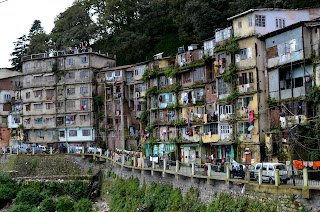
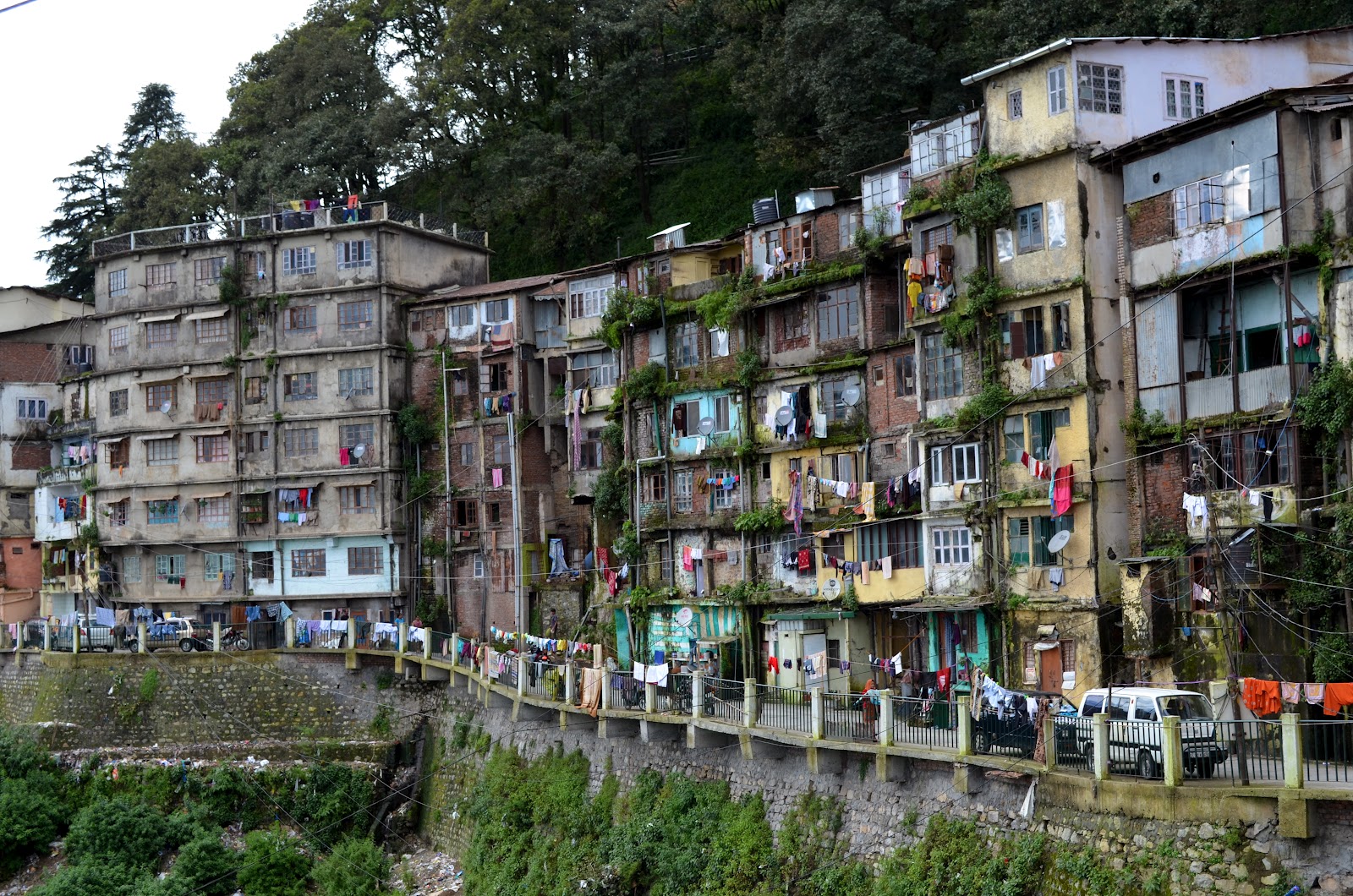
Mussoorie is like Delhi's infant sister. You see the same colors, clothing, dilapidation and liveliness, the same tiny shops, food stalls, and stray dogs, the same narrow streets, nonexistent sidewalks and crazy drivers, and yet, everything is infinitely more calm. Here, crazy drivers means a single car thundering around a curve with complete disregard for other beings in the road, whereas in Delhi it would probably be ten cars, seven motorcycles, five rickshaws, three trucks, two bikes and various pedestrians all attempting that same maneuver. Here, even when it's bustling and the streets are buzzing with people's energy, you still have space, and fresh, unpolluted, crisp-smelling air to yourself. Here, you have all the time in the world to stop and stare and take in the dazzling surroundings.

Our group spends evenings either with a Hindi tutor, at the Woodstock gym, in town, or just hanging out. Ada and I, while both sick in bed, were the first to venture into the wonderfully ridiculous world of Bollywood, watching movies complete with random dance numbers, murder, corruption and reincarnation. We even discovered our first favorite Bollywood songs/dances, which I'll post here for you to enjoy as well:)  


Until next time,
H


Tuesday, September 4, 2012

A Journey Between Two Extremes

Written on Sept 2, 2012

The past two days sit in my mind in stark contrast to each other. Yesterday, day two in hot, humid, sweltering Delhi, began with a walking tour of one of Delhi's poorest neighborhoods, an area in which many street kids - children as young as five years old who have run away from home from both near and far - converge. The tour was organized by an organization named Salaam Balak, whose goal is to assist, nurture, educate and provide homes to street kids in Delhi. It was led by a former street kid - a man named Iqbal who, as a five-year old, ran away from home and boarded a train to Delhi in order to escape his parent's abuse, and who, after working some odd jobs and trying to survive on his own found his way to one of Salaam Balak's shelters - all before his seventh birthday. Iqbal - cheerful, optimistic, well-spoken, and full of dreams - asked us all to guess where in India he was from, and after we all threw out the names of the various Indian cities we know, he smiled and told us that even he didn't know the answer to that question.

His tour took us through narrow, damp, fly-filled streets, dotted with hole-in-the-wall barber shops, crumbling buildings, shrines to the Hindu gods, little food vendors, and both the begging and the motionless poor. 


Iqbal then took us to one of Salaam Balak's shelters, a temporary home for boys aged 6-14. The second he brought us into the room in which the boys were gathered, it turned to pandemonium. We were swarmed by the kids, calling out to us "didi, didi!" ("big sister"), reaching out to shake our hands, telling us their names, jumping, climbing, grasping, yelling. They radiated energy, pure and unadulterated, running around the room, bouncing off the walls, meeting each one of us, taking pictures with our cameras and chattering away in Hindi that we couldn't understand. 


In the room, playing with the boys, it would have been impossible to comprehend - and it didn't even really hit me until now - how much life they've lived already. It's not simply that they're poor, that they're living in a shelter, or that they were abused (most likely) - those are problems that we're familiar with in the United States. The thing that is truly impossible to believe is that many of these six-seven-eight year old kids have lived even more life than I have - they've been on their own, traveled across country, lived completely alone, fed themselves, tried to make their own way - and all in a city as congested, hectic and unforgiving as Delhi.

In the afternoon, we walked around Khan Market, what is considered Delhi's upscale shopping area, full of expensive foreign brands, in addition to fancy Indian ones. Even there, despite the extremely apparent difference from the slum-area market - much fewer people, more Western clothing, less trash, better smells - it was still a "marketplace" full of old, crumbling buildings, dirty streets, zig-zags of phone wires, beggers, pollution and a general run-down atmosphere. It was like nothing you would ever expect to see in the nicest neighborhood of a capital city in the United States or Europe. But, from my two days of experience in Delhi, it fit in perfectly there. Delhi, intoxicating, interesting, and overwhelming, is dirty, congested, run-down, a weird mix of sprawling impersonal city and underdeveloped village. It's vast - more vast than you could ever imagine - and filled with more people than you could ever imagine - people that are constantly out and everywhere, walking, driving, biking, working, all going in different directions, all almost colliding, all with nowhere to breathe because even in the open spaces, the air is too dusty (and often smelly) to get a good breath.

Now place that in contrast to the place I am writing from now: on Sunday morning, we took the Shatabdi Express from Delhi to Dehra Dun. The train ride was around six hours and breakfast lasted for at least half, if not more, of the time. Breakfast was a whole affair, with many different courses and rounds of tea periodically being served. Upon arrival in Dehra Dun, we took taxis on an hour ride up through the mountains, the streets gradually narrowing, the turns sharpening, the incline steepening and the cliffs growing. We drove up and up, past signs marking the rising altitude, past monkeys sitting on the side of the road, past little villages full of little school chilren, past lush greenery, all the way until we reached the mist-laced city of Mussoorie.

Mussoorie is where I'll be living for the next three weeks for orientation and intensive Hindi classes - and it is one of the most beautiful places I've ever seen. Everywhere you look there is rich green foliage and all surrounding us you can see the verdent mist-shrouded foothills of the Himalayas dotted with little villages and winding roads. The mountainside is unbelievably steep and, looking over the edge of the road, you can see these incredibly deep drops, covered in trees seeming to grow sideways out of the mountain. The most beautiful part of Mussoorie, however, is the mist. Most of the time you can see it moving in wisps right past your face, dancing and swirling as it travels. And boy, does it travel. If you stand, looking out over the mountains you can see the mist moving, rising up like an all-powerful being from the depths of the earth, becoming amorphous, joining with other clouds of mist, shifting, growing, whiting out the sky and the green in a matter of seconds - and then clearing again soon after. At times, when the mist is rising from below, thick and heavy, it feels like you are watching the earth being born, peaks rising out of the thick nothingness of the fog, a wonderous creation emerging out of a steaming pot. 


When you compare this to Delhi, it is difficult to believe that it is even the same country. One is ruled by human needs and the other by the law of nature. One raises your hearbeat, the other calms it. Being able to experience both places in quick succession has been a really amazing lesson in India's diversity and has truly opened my eyes to what India has to offer.

Friday, August 31, 2012

Traffic

This post concludes my first day in India, a colorful, dusty, muggy, intense, loud blur of a day. We arrived at the Tibetan Colony of Delhi late last night after a taxi ride from the airport spent slipping back and forth between lanes, narrowly sliding past nearing trucks, dodging overcrowded motorcycles driving the wrong way, and nearly hitting wayward pedestrians. Walking through the narrow, dim alleyways of the Tibetan Colony, exhausted after a fifteen hour plane trip, I had almost no sense of where I was or what Delhi was like. All I could think about was putting down my 30-pound backpack and taking a nice, refreshing shower. And then I saw the shower. A loose shower-head and a bucket sitting in a bathroom whose door didn't close. But, in the spirit of my trip, one of reevaluating my own standards and embracing a new way of life, I just jumped right in. And a room that, upon first entering, had appeared dirty and dismal, and had caused the mind involuntarily to recoil, suddenly became comfortable and clean.

In the morning, after spending just over a dollar on an exotic tea and a delicious crepe-like pancake, Ada, Mackenzie and I walked around the Colony, cautiously navigating the alleyways, beggars and stares of passerby. If you've ever been to Old Havana, it looks a lot like that: dilapidated buildings with dangerously rusted balconies and uneven cement, dirt-encrusted ground. The only difference is the plethora of tiny street-level shops with neon signs and flashy interiors. At the end of the main, pedestrian-only thoroughfare is a small park, the sky striped with lines of Tibetan prayer flags, the benches dotted with red and orange-robed Buddhist monks.


Soon drenched in sweat, we returned to the hotel for a briefing on India and another laughably cheap meal.

It was only after lunch, though, that the action really started. We took a taxi to Old Delhi, where we all hopped on rickshaws for a makeshift "tour." The first thing that comes to mind when thinking about Old Delhi, the one word that sums is all up, is the traffic. But not in the LA sense, the unmoving line of vehicles sense; rather, when talking about Old Delhi, traffic is the literal traffic - the many different beings that make up the jigsaw puzzles that swarm the streets. Traffic means rickshaws, motorcycles, trucks, bikes, taxis, business men, old women, young children, teenagers, dogs...all darting in front of one another, edging other beings and vehicles out of the way, stopping short, almost colliding, starting up again, and honking, always honking. It would come as no surprise then when our rickshaw turned in to oncoming traffic or drove the wrong way down the street. That was simply the way things worked.


It is true when I say that the most striking thing about Old Delhi was the traffic. The buildings, the signs, the leaping monkeys, the street vendors serving up what appeared to our safety-briefed eyes to be Giardia-invested delicacies, the many silks and colors were all secondary. But the colors were certainly a close second. Colorful signs and silks, rainbow fruit stands and saris, painted rickshaws and advertisements, all competeing, clashing and combining in to to an overwhelmingly interesting whole.

Through congested thoroughfares and narrow alleyways, our rickshaws fought their ways, yelling and swerving and turning around to try and haggle with us for more money. We left them at the Jama Masjid mosque, a massive, red-stoned, fortress-like building. Upon entering, Mackenzie, Ada and I were unceremoniously wrapped in flower-printed kimono-like robes by a old man with a hawk's-eye for Western (inappropriate) dress. The inside, a huge open square surrounded by minaret-topped prayer rooms, was a people-watcher's heaven. There were groups of women in beautiful saris, packs of men in white prayer robes, little children feeding pigeons and families, wandering.


Then, the staple adventure of Delhi was repeated: another crazy auto-rickshaw ride later, we arrived back at the Tibetan Colony. Time for things like Chai, semi-functioning air conditioners, and people offering to clean out your ears. One day down, and still processing, I leave you with that - very Indian - image.

Friday, August 24, 2012

Hello

This morning I said farewell to my house, my dog and my hometown, got in the car with my massive, stuffed to the brim backpack , and began an adventure. I'm off to Princeton for Bridge Year orientation, where I'll meet my fellow travelers and begin to learn about the country that will be my home for the next year.

On Wednesday, I'll say farewell to western toilets, running water showers and American clothing, and board a plane to India.

On Thursday, fifteen hours later, I'll be greeted by a sea of people, colors, smells, sounds and sights, all new, probably not all wonderful, but certainly all combining to create an exciting whole.

So really this isn't a trip of farewells, but a trip of infinitely many hellos.
 

Wednesday, August 15, 2012

Countdown

In exactly two weeks I'll be boarding a plane to India and beginning my nine month adventure there. I'm going to India on Princeton University's Bridge Year program, a really amazing program that allows students to defer their freshman year and sends them to one of four different countries (India, Peru, Senegal, China) to do meaningful, long-term volunteer work and to immerse themselves in the surrounding culture. I'll even be living with a home-stay family and taking intensive Hindi classes! I've always loved traveling, and ever since I was a little girl, I wanted to take a gap year and travel the world, so I'm incredibly excited for the opportunity to spend nine months in India.


Of the nine months, seven will be spent in Varanasi (also known as Banaras), a large city in north-east India. Varanasi sits on the Ganges River and is considered one of Hinduism's holiest cities. It is also one of the world's oldest continuously inhabited cities! The other two months (the first and the last) will be spent in various places in the Himalayas. More on that to come.

But, for now, back to the present. I've been in preparation mode all summer long, running from REI to EMS to CVS, stocking up with a million sticks of deodorant, as well as buying my first ever pair of hiking boots (yes, I was that person who insisted sneakers could serve any situation). Other than a crazy dash to New York to get my visa, it's been a very calm summer, and I'm feeling ready for the exciting changes that lie ahead. I know that India will be a huge change from my hometown of Boston, but different is always interesting and I'm so looking forward to the millions of things there will be for me to learn.